
Disclaimer: George worked for both the DSIR ChemDiv and Industrial Research Limited and, as everyone will tell you, is prone to viewing the science landscape through rose-tinted glasses. He doesn’t think he made anything up completely but perhaps check with Auntie Google.
MBIE is beavering away setting up the New Zealand Institute for Advanced Technology (NZIAT) that will, according to the MBIE website, “drive scientific discoveries in advanced technologies for real-world impact and economic growth.”
This is obviously a very good idea, and, I’m hoping this won’t make you fall over backwards in surprise, one we (as in New Zealand) have had before. I thought it might be timely then, to have a look at how previous attempts have gone before we set out to reinvent the jandal.
The NZIAT currently consists of a Board, a $70ish million over 7 years contract with Victoria University’s Robinson Institute on ‘Future Magnetic and Materials Technologies,’ a yet to be awarded contract (delayed? – another $70m over 7 years) on ‘Artificial Intelligence,’ a little bit of funding (the money was running out) to identify potential areas for funding in ‘Quantum Technologies,’ and some hand waving (money all gone) towards ‘Synthetic Biology.’ It has also inherited a repayable loan scheme for start-ups, support for MedTech companies, and the Product Accelerator, which connects industry to a network of largely university-based researchers. Recently it acquired a CEO (exOranga Tamariki, who everyone likes and tells me off for raising my eyebrows in the direction of their CV), some admin staff, and some money from the 2026 Budget for later. And a website (https://www.nziat.co.nz/ )
A number of commentators, including, sadly, myself, have traced the first New Zealand attempt at “unlocking insights that drive scientific discoveries in advanced technologies” (MBIE website on the NZIAT again) back to the founding of the DSIR in 1926 – the birthday party is being arranged as we speak https://sciencenewzealand.org/100-years-of-impact. However, a little digging quickly shows that the early days of the DSIR were dominated by solving the issues of the primary sector. The early colonial habit of burning down the bush and sprinkling what was left with grass seed and sheep was wearing thin, so there were a lot of scientific problems to solve to get the nation’s agriculture on a stable footing that the DSIR had to address.
It wasn’t until after the Second World War, when New Zealand’s success in developing munitions, radar, and radio equipment for the Pacific Theatre, led Sir Earnest Marsden (do you mind if we call him Ernie – apparently everyone did) to try to bring the advanced technologies of the time to New Zealand manufacturing Industry. Ernie directed the DSIR’s Physics and Engineering Laboratory (PEL) in Wellington, along with manufacturing industry facing labs set up in Auckland and Christchurch (notably in conjunction with the forerunner of Canterbury University) to modernise New Zealand industry.
These groups ended up helping in the startup of famous names like Fisher and Paykel Healthcare and Buckley Systems (still amongst New Zealand’s only world leading technology companies). And, indeed, it was at the PEL, in 1985, that Bob Buckley and Jeff Tallon started the work that led to the Robinson Institute being the core of the NZIAT and establishing arguably New Zealand’s currently sexiest start up – OpenStar Technologies (although maybe the odds are with Cullbeck). They read a paper on high-temperature superconductors, thought, “yeah, we can do that” (or possibly something more elegant), fortunately writing their thoughts down on a sandwich bag, and got on with it.
However, in the midst of one of New Zealand’s more bizarre policy enthusiasms, Public Management Theory, in 1991 the DSIR was bundled up with bits of MAFTech and the Forest Research Institute and then broken up into 10 ‘companies’ to be called Crown Research Institutes (CRIs). In making the changes, Simon Upton, the science minister of day, deliberately made the CRIs sector-facing because he felt the DSIR was not closely enough connected to the New Zealand industries it served, and by breaking it up into smaller more responsive chunks, with a direct connection to (and a financial dependence on) the sectors, the chunks would be more likely to work with them. Which is fair enough if you have a sector to face.
But not all of the bits of the DSIR had sectors, so the subject oriented (sector-facing: think the Forest Research Institute, subject-oriented think universities – one day I will write a piece on the difference) parts of the DSIR, PEL and Chemistry Division (ChemDiv), were rolled up together with the industry-serving groups in Auckland and Christchurch and some other odds and ends and sent off to start Industrial Research Ltd (IRL) to support the manufacturing industry.
By the time we (sorry, very often when I say ‘we’, I mean New Zealand) thought to get a clear statement of purpose for the organisation, in 2010, it was to:
- increase the contribution of knowledge-based businesses to the New Zealand economy,
- provide research and development services in industrial technologies, materials, and manufacturing processes
- foster the development and commercialisation of new technologies that benefit key national industries.
So, no mention of investors, because, to be fair, we didn’t have too many of those in 1991 or even 2010, but I’m calling IRL the second attempt after Earnie with the DSIR “to connect researchers, industry, and investors – unlocking insights that drive scientific discoveries in advanced technologies for real-world impact and economic growth”; that MBIE website again.
And how did that go? Well, not so badly. The former DSIR PEL people kept working on superconducting materials and had some fun with trying to commercialise them. They spun out a company, HTS110, to make superconducting tape and magnets in 2024, which was bought by New Zealand automation company (the automation side also helped by IRL) Scott Technology in 2011, and then spun back out from them in 2021. There were a number of other high-tech spinouts from IRL, but nothing that set up a whole new sector. A lot of small companies had research done and grew – the ‘Plastic Fantastic’ yacht that won the Americas Cup in 2004 had a lot of IRL technology in her. The Carbohydrate Chemistry team kept on developing drugs. The natural products people (me included until I turned to the Grey Side) worked away testing biological activity and developing manufacturing methods, helping the sector grow from a small domestic market to a decent export contributor (along with a lot of other science organisations, obvs).
But it was always a struggle for IRL. New sectors have no money, small companies have small budgets, and when more than half your research income needs to be commercial it’s hard to find funding. Advanced technology companies need new expertise and equipment you don’t have in your organisation and by the time you get it, they’ve often collapsed or moved on. Both these factors push you back to serving established businesses. To get around this, IRL started some significant subsidiaries to build their own impact, notably KiwiStar Optics, GlycoSyn and the company that effectively killed IRL, BioPharm.
BioPharm is a very clear warning of what can happen to new sector start-ups that stay with their institution too long. BioPharm could do something almost nobody else in world did, coupling antibodies to neurotoxins under full Good Manufacturing Practice (GPM, the standard needed to manufacture material for clinical trials), a complex, dangerous business. For a while they were wildly successful and the Board of IRL hung on to them to milk the cash cow. Then it all went down in a screaming heap. It turned out that IRL couldn’t invest enough for BioPharm to have the equipment required for them to seek a wider range of clients, or to scale up when existing clients needed big volumes. They went out of business and IRL needed an $11million bail out from government (when $11 million was worth something). A bit of a personal rift between IRL management and the research bureaucracy, a restructure of the funding system, and IRL was gone, turned into Callaghan Innovation.
Ultimately the long term impact of IRL wasn’t spinouts but space and people and supporting the technical ecosystem that make advanced tech possible. Lanzatech, once one of New Zealand’s billion dollar companies (now sadly in the US and not doing so well) started in spare space on the second floor of the old DSIR building in Auckland that IRL inherited. Rocket Lab founder Peter Beck worked in the IRL workshop as he got his ideas together. Aroa Biosciences (getting their turnover up nicely at the moment but not, disappointingly, their share price) occupied space in the old IRL BioPharm facility in Wellington and used people who had learned GMP in that debacle. BioOra started out on the Gracefield campus in Callaghan days as well. These companies got cheap rent and contact with the IRL staff, informal and paid for, that helped get them going. There’s still a range of little companies working away in those spaces (I just saw them advertising for more) and I’m sure we’ll hear more from some of them. The problem comes when you flashup these old spaces, put in support services and start charging rents that genuine start-ups can’t afford (another hobby horse of mine to be dealt with later).
Let me say upfront that I thought from the start that Callaghan Innovation was built on a flawed model (and I’d already left IRL so it wasn’t personal). There was the opportunity to think about what had happened with IRL and build a decent Advanced Technology Institute that would have worked for industry, but it would have been expensive. We had a nice report written for us on what an ATI would look like (Powering Innovation: Improving access to and uptake of R&D in the high value manufacturing and services sector) and ignored it. In the event, most of IRL’s research function went into Callaghan under even more commercial funding pressure and weirdly, in my view, almost inconceivably, all the government grants to industry for R&D were handed over to the same organisation to manage.
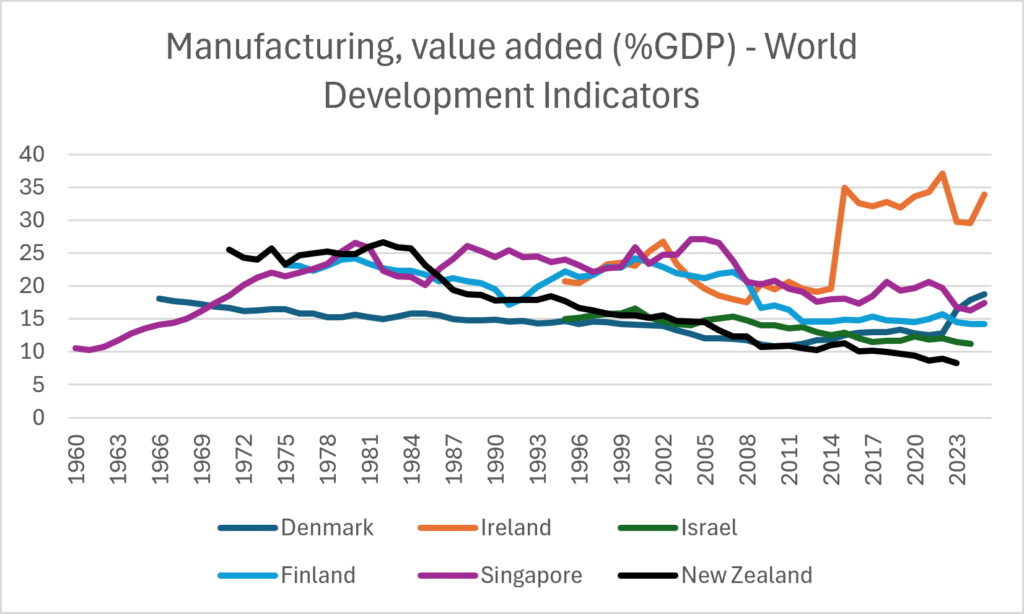
Giving grants to industry to encourage and de-risk investment in R&D is a wonderful and necessary thing, but it doesn’t sit easily with managing research. Handing out money is always exciting, it comes from offices in town and people in nice clothes who wave their hands when they talk. They get praised. You need nice boardrooms and you can set up flashy internet portals whose purpose is obscure and success unmeasured. You can copy Finland, or Denmark or even, remarkably, Israel. Your recipients are always grateful.
Research on the other hand is dirty and expensive. It happens in out of the way labs with people who have built up experience over the years. Your clients are often disappointed that you couldn’t bend the laws of nature to their will. So the research part of the organisation gets neglected and underfunded as the handing out money part gets the attention. There is the demand that the researchers get significant commercial income, which the cutting edge can’t afford, and there is no money for new staff and equipment (so how can you stay cutting edge?) and it all went pretty much as you might expect for Callaghan.
Which is to say the handout-money bit went well, along with quite a bit of ra-ra!, but the research fell away. As Callaghan is closed down in these latest reforms, the only research team felt to be worth saving was the Bioscience team which is going to one of the new Public Research Organisations. The handing out money bits are getting spread around the place (the change from grants to tax credits had already pretty much knee capped that part already).
However, back in the 2010 wind up of IRL two groups were, after a little back and forth between Otago and Victoria, taken out of Callaghan as university research groups by Vic. One was the Carbohydrate Chemistry Team (now the Ferrier Institute) and our old friends from the DSIR, the PEL materials group (now the Robinson Institute). Both groups came out of the CRI system with money, which universities like, to get them started, but it’s been a bit up and down for them both while they got on with doing what they do.
Back to the present and the current set of reforms. I think they should have gone further and undertaking them in the absence of new money is a disaster. The two things (the three things, to quote Monty Python – I also think increasing the size of the CRIs in forming PROs was a good idea, but the money thing is crippling it) I really like are the breaking up of the funding pool into subject areas and the formation an NZIAT.
New Zealand will always need something like an Advanced Technology Institute but it’s not easy to get industry to take up advanced technology, especially, as I’ve said before, in an economy dominated by capital in housing, putting milk powder in big boxes and keeping tourists well exercised, fat and happy. What the DSIR did was pretty good, if a bit lost in the size of the operation, and we are still reaping the benefits. IRL was OK, and we had the chance to do better when it was sunk by poor management and personality conflicts. However, we ended up with Callaghan Innovation instead, which was a lot better with grants than it was with research into advanced technology.
What can we learn from these adventures that might help us this time around?
Overnight Sensations take time: We can trace the core of the NZIAT, the Robinson Institute, and New Zealand’s hottest start up, Openstar, to a conversation in a tearoom 40 years ago, and the ability to even have that conversation to Ernie wondering what to do with his people at the end of the Second World War. The NZIAT needs to have as long a time horizon as possible.
It will not always be popular: All the big New Zealand advanced technology science success stories I know about have come in and out of favour before they were successful. Except maybe Lanzatech: everyone thought they were cool from the start, and I’m guessing Fisher and Paykel Healthcare was always well received. The superconducting research people variously struggled for funding, won the Prime Minister’s Science Prize in 2009 (ironically just as IRL was disestablished), then struggled with the funding system in Victoria again before secure funding in the NZIAT. In seven years which isn’t long, as this funding runs out, how will they be looking? The NZIAT needs to have confidence in the long term vision for their projects.
It is not a fashion parade: AI is big in the international press (especially now as the backlash to AI builds) and makes for buzz words easily picked up by Ministers but is it where New Zealand can build success in research or applications? I think the NZIAT would be better off looking for areas of deep core expertise, like they did with materials, and funding that rather than identifying a sexy topic and funding whatever turns up just because the rest of the world is funding that topic. There is no point in funding second rate ‘cutting edge’ technology. The NZATI needs to identify technology areas that New Zealand has real capacity to research and exploit. [And on that note, it’s both reassuring and frustrating to see the NZIAT’s progress on awarding funding to AI and quantum. The big worry is the Transition Fund just pushing the money out the door towards old projects in new clothes to meet arbitrary targets when the projects were fine as they were].
The biggest contribution by an ATI to emerging sectors will be people and expertise, not spin-outs: Spin-outs from a government agency (or indeed a university) are always risky and suffer from the institutional shareholder having mixed objectives for their investment. The most reliable transfer of technologies comes from trained staff and access to facilities. Its always tempting to enforce this by having commercial income targets for the institution, which is fine for an established sector, but useless in a new ‘cutting edge’ area. The NZIAT needs to take a broad view of sector growth as its metric, not just its own income, and subsidise access through grants for its services and internships and so on. It shouldn’t get distracted by managing grants in general.
It takes money: all of the above take committed long term funding and success monitored not by individual projects but by growth of the sector as a whole. Investment from the private sector, yes. Fee for service, no. It only works for existing technology companies and sectors.
So where does that leave us with the NZIAT so far?
I like the investment in the Robinson. It’s great to see investment in capability with a long term record of success that was put at risk by the vagaries of the existing funding system. I hope the contract says something like “Get on with it, people!” and doesn’t have a heap of manufactured milestones. I worry about them being a university department with all the overhead and complexity, but I like the access to students and existing facilities and support, so I’m torn on the business model. But let’s find more of groups like this.
Let’s not take sexy areas from the international press and bung something into the Institute to say we are up with international trends in the hope that it takes off. I’m OK with synthetic biology, broadly framed (although obviously I would be) because that is one of the things NZ does. Quantum is too vague (everything is quantum) but in some areas we have groups we could support, maybe a bit away from commercialisation, but getting there. Let’s spend some money on basic science to build strength, and that much abused term excellence, and work from there.
AI is an enabler (or often disenabler: it’s early days for LLMs, however fashionable) and I remain to be convinced NZ has research to make a difference. Adoption of AI where it’s useful, totally, but that’s not research for an ATI.
I worry that the current components are a rag-tag of disparate things: an expensive funding agency, a manager of technology loans, industry-cluster support, and advanced manufacturing support. I think the NZATI needs to focus on developing new technologies for New Zealand and bringing those technologies to New Zealand industry. Through startups or existing companies adopting the new technologies, it doesn’t really matter. The general technology support functions are a distraction. The Product Accelerator does great things and the MedTech stuff is also great but I don’t think they belong in a technology research Institute.
So, I think the bones are there. A tidy up (and a lot less pressure from politicos) and we should have progress.

